
Sept. 21, 2022: Endogenous Collaterization 💥💵🇺🇲
Sept. 21, 2022: Endogenous Collaterization 💥💵🇺🇲
Here we go again...

Last night crypto Twitter exploded with yet more bad news for our bags. A series of articles made the rounds about a draft US bill that could neutralize stablecoins.

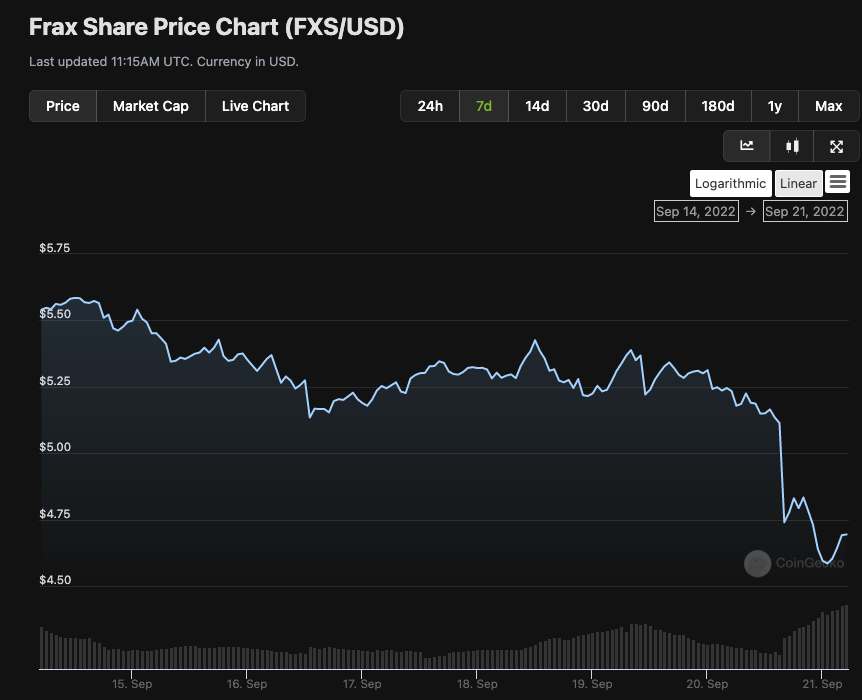
It’s always a good time to panic! $FXS tumbled 10% on the rumor. A story in four parts…



What is actually going on? The great @easonwu was quick to pen a summary:


Our torpid legislators are very far away from actually doing anything with regard to this bill. This bill is still in a draft stage, which means it hasn’t even hit the Congressional register yet. This puts it well behind several other existentially threatening stablecoin bills that have seen no action:
HR 7328: Stablecoin Transparency Act, Trey Hollingsworth, March 31
S 3970: Stablecoin Transparency Act, Bill Hagerty, May 10
HR 4741: Digital Asset Market Structure… Donald S. Beyer Jr., August 13
S 4356: Responsible Financial Innovation Act, Lummis/Gillibrand, Sept. 15
A potential fifth bill marks a slight uptick from the 116th Congress (2019-2020), which had three bills go nowhere.
For any of these drafts to become a law, they would need to go through the usual sausage grinder, in which they got gussied up with hundreds of pages of irrelevant kickbacks to swing state politicians.
With only 9 weeks left in the legislative calendar, it’s quite unlikely Congress will prioritize their attention toward combining these various snippets into some sort of horrendous Frankenbill.
That said, there’s always reason for concern when poorly crafted legislation hits the docket. From the leaks, this certainly appears to be in the “poorly crafted” bucket.
The first thing to note is the sense of increased urgency around DC caused by the UST debacle. Not only did Do Kwon make us all poor, he might wind up getting American crypto users tossed in jail before him.

Whenever Congress finds bipartisan consensus on an issue, you can just about guarantee the general public will take a steel-toed boot squarely to the face. The leak should therefore be of some concern because it’s allegedly being co-sponsored by Patrick McHenry, previously considered a crypto champion. We give him a pass while this is all in the rumor stage, but it’s possibly bad news to whomever bid up his NFT in the PAC DAO Congressional auction.
The language in the bill raised eyebrows by referencing “endogenously collateralized” stablecoins, a term which made us fondly recall our high school biochemistry class.

For backstory, the first time I heard this term it was attributed to @LucaProsperi from this interesting thread:

This terminology was making the rounds at least a month earlier though, as it appears Ser Brito is the one who taught our representatives to use such foul language.

It seems quite possible the language is being used just to make Congress sound smart. It’s fashionable to complain that the ignorami in DC haven’t done their homework, so they may be parroting this language in a maneuver to appear intelligent.
An “endogenous” system is considered to be one in which the system is backed by collateral within its ecosystem. $LUNA was endogenous to $UST, whereas the US Dollar exists outside the scope of $USDC, making it “exogenous.” The ~8% of FRAX that is backed by burning $FXS would be considered endogenous, so 🧠 would simply adjust its algorithm accordingly if needed.

If we’re busting out the technobabble, we’d prefer dipping into thermodynamics to reuse exergonic and endergonic reactions, relating to the change in Gibbs Free Energy it could cause to a system. Or perhaps simplify it to a chemical exothermic/endothermic reaction to refer to the enthalpy change — the big issue with LUNA’s collapse was it was exothermic and nuked everybody else’s markets.
Congress has a few motivations on display here. The first motivation may be to clear the field for a CBDC, a topic already en vogue this week and one we plan to cover more extensively in a future article. At any rate, it’s silly to presume that a CBDC would be directly competitive with stablecoins sporting a wildly different use case. Quite the opposite — a robust ecosystem of successful stablecoins would only enhance the utility of a CBDC.


The other motive for Congress may be the more altruistic idea of forestalling another UST-style collapse. It can be a bit tough to fault Congress’s intentions if this is in fact the case. The Terra collapse was indeed a horrendous spectacle to observe, and several people got hurt very badly, so we’d all prefer a world where such collapses didn’t occur.
The “endogenous” language may simply be a good-faith attempt to single out stablecoins like $UST (which was mostly backed by $LUNA), but it’s not clear the language in this bill would succeed in these aims. At the time of collapse, Terra was on track to have their stablecoin primarily backed by exogenous collateral in the form of Bitcoin, but fate would intervene before they could reach this mark.
The question of jurisdiction also comes into play. America’s actual actions notwithstanding, it’s far from clear the US actually has the legal authority to police entrepreneurs in other countries. Various parts of our legal system have advanced flimsy arguments for why America does indeed possess such authority, most recently on display in Gensler’s latest absurd power grab.


If the bill as written were to actually pass into law, it would primarily have the effect of crippling America. It’s in our national interest to keep stablecoin innovation here in the United States. Keeping the entirety of DeFi denominated in dollars is a national security concern. We gain a lot from dollar dominance, so promoting a healthy ecosystem of dollarcoins is our best bet at extending this power into the new economy. Scaring away attempts to create dollarcoins directly undermines our prosperity.
Stablecoins are also among the hottest areas of innovation, combining both the bleeding edge of technology and a wildly popular product-market fit. The effect of placing such limits on stablecoin innovation would literally just relocate innovators into jurisdictions that don’t give a crap about our bloviations. We’d continue to see stablecoin experiments, but they’ll be headquartered outside the reach of US enforcers. Keeping Sam Kazemian building in America is the top priority!
Besides which, it’s all a little bit silly. Scammers aside, nobody trying to build a stablecoin wants it to collapse. The honest builders are watching Terra and taking notes about how to keep that from happening. They don’t need legislators to tell them UST was an unsound ponzi. They’re too busy looking at the stablecoin formulas that actually work and expanding upon these.
If Congress does place a ban on poorly designed stablecoins, is that a bad thing? It’s possibly preferable to instituting a blanket ban. Yet the definitions of “endogenous” and “exogenous” are plenty confusing, and likely to create all sorts of crazy gray areas. We also know regulators are always frothing to test just how far they can overstep their boundaries, so we’d likely see all the good projects attacked under such a law.

As written, the language could actually ban the USD itself, which is itself an algostable with inferior tokenomics.


If for some reason somebody was desperately interested in building a horribly unstable UST clone, the legislation is also laughably simple to circumvent. UST launching under the same banner as Terra may be illegal, but spin up a different multisig and website and it’s “technically” an exogenous project. Expect the full force of the US policymakers could be easily outmaneuvered by a Lionel Hutz caliber lawyer.


The Boomer Simpson meme energy is stronk today…
For those concerned about what this may do to a potential $crvUSD, Curve noted it’s business as usual, reiterating that the only victim of this legislation would be America itself.

The sad part about all this is that it would be quite possible to craft useful regulations that improved the space. Shoehorning DeFi into a TradFi framework is not that…


Such nice “endogeneously condensed” takes that informs and quickly bring one up speed with the latest on the macro stablecoin FUD. good job ser